
Show:

Book
Revealing the Unseen. New Perspectives on Qajar Art
Edited by Gwenaëlle Fellinger & Melanie Gibson
This new book, a co-publication with the Louvre, consolidates the major achievement of the 2018 exhibition held at the Museum of Louvre-Lens, L’Empire des roses. Chefs-d’oeuvre de l’art persan du…
View
Book
Mirzā ʿAli-Qoli Khoʾi: The Master Illustrator of Persian Lithographed Books in the Qajar Period. 2 vols. Leiden: Brill, 2022.
Authors: Ulrich Marzolph and Roxana Zenhari
Mirzā ʿAli-Qoli Khoʾi is the unsurpassed master of the art of illustration in Persian lithographed books of the Qajar period, both in terms of quality and quantity of production. In the decade of documented…
View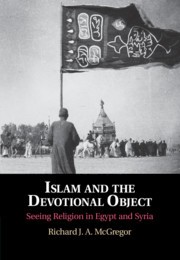
Book
Islam and the Devotional Object: Seeing Religion in Egypt and Syria
Richard J.A. McGregor
Islam and the Devotional Object offers a history of Islamic practice through the aesthetic reception of medieval religious objects. Elaborate parades in Cairo and Damascus included decorated objects of…
View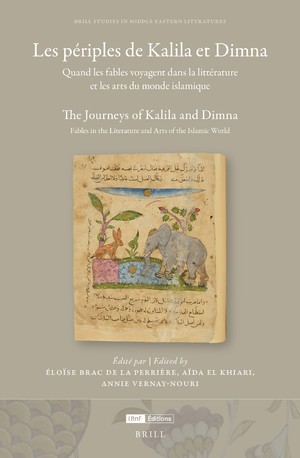
Book
The Journeys of Kalila and Dimna: Itineraries of Fables in the Arts and Literature of the Islamic World
Editors: Eloïse Brac de la Perrière, Aïda El Khiari, and Annie Vernay-Nouri
Kalīla wa-Dimna is one of the best-known texts of medieval Arabic literature and counts among the most illustrated works in the Islamic world. The extent of the corpus and its journey through the ages…
ViewBook
City in the Desert, Revisited: Oleg Grabar at Qasr al-Hayr al-Sharqi, 1964-71
by Christiane Gruber and Michelle Al-Ferzly, with a foreword by Renata Holod
Between 1964 and 1971, renowned Islamic art historian Oleg Grabar directed a large-scale archaeological excavation at the site of Qasr al-Hayr al-Sharqi. Drawn to the remote 8th-century complex in the…
View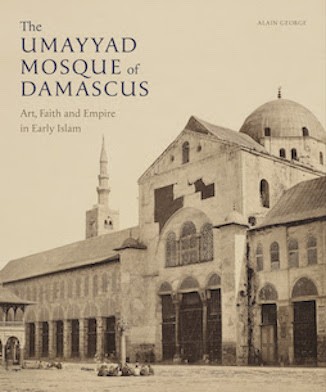
Book
The Umayyad Mosque of Damascus: Art, Faith and Empire in Early Islam by Alain George
The Umayyad Mosque of Damascus: Art, Faith and Empire in Early Islam by Alain George edited by Melanie Gibson The Great Mosque of Damascus is an iconic monument of world architecture, and the oldest…
ViewBook
Antique Dealing and Creative Reuse in Cairo and Damascus 1850-1890: Intercultural Engagements with Architecture and Craft in the Age of Travel and Reform, by Mercedes Volait
The commodification of Islamic antiques intensified in the late Ottoman Empire, an age of domestic reform and increased European interference following the Tanzimat (reorganisation) of 1839. Mercedes Volait examines the social life of typical objects moving from Cairo and Damascus to Paris, London, and beyond, uncovers the range of agencies and subjectivities involved in the trade of architectural salvage and historic handicraft, and traces impacts on private interiors, through creative reuse and Revival design, in Egypt, Europe and America. By devoting attention to both local and global engagements with Middle Eastern tangible heritage, the present volume invites to look anew at Orientalism in art and interior design, the canon of Islamic architecture and the translocation of historic works of art
Visit siteBook
Elisabeth Fraser, Mediterranean Encounters: Artists Between Europe and the Ottoman Empire, 1774-1839, PSUP
Mediterranean Encounters: Artists Between Europe and the Ottoman Empire, 1774-1839 is now out in paperback.
(30% discount with promotion code NR21.)
Book
The Queen of Sheba's Gift: A History of the True Balsam of Matarea, by Marcus Milwright
The death of the last balsam tree in the plantation of Matarea in 1615 marks the end of practice of specialised cultivation that can be traced back two millennia. This interdisciplinary book uses written sources, visual data, and archaeological material to reconstruct the fascinating history of the balsam tree from Jericho and En-Gedi to Egypt, while also establishing links with resin-producing trees from the Arabian Peninsula and the Horn of Africa. Chapters address the symbolic associations of balsam and the site of Matarea, the distribution of products from the tree through trade and diplomacy, and the applications of these products in medicine, ritual, and the domestic environment. These chapters allow for an exploration of the complex socio-cultural factors that contributed to the sense of value accorded to rare commodities.
For more information, see.
Book
The Mobility of People and Things in the Early Modern Mediterranean The Art of Travel, Edited by Elisabeth A. Fraser
For centuries artists, diplomats, and merchants served as cultural intermediaries in the Mediterranean. Stationed in port cities and other entrepôts of the Mediterranean, these go-betweens forged intercultural connections even as they negotiated and sometimes promoted cultural misunderstandings. They also moved objects of all kinds across time and space. This volume considers how the mobility of art and material culture is intertwined with greater Mediterranean networks from 1580 to 1880. Contributors see the movement of people and objects as transformational, emphasizing the trajectory of objects over single points of origin, multiplicity over unity, and mutability over stasis.
Contents:
Introduction: The Mobility of People and Things in the Early Modern Mediterranean: The Art of Travel - Elisabeth A. Fraser; 1 "From Scorching Spain and Freezing Muscovy": English Embroidery and Early Modern Mediterranean Trade - Sylvia Houghteling; 2 A Tale of Two Guns: Maritime Weaponry between France and Algiers - Meredith Martin and Gillian Weiss; 3 Furnishing the Taste for Coffee in Early Modern France - Julia Landweber; 4 Substitutes and Souvenirs: Reliving Polish Victory in "Turkish" Tents - Ashley Dimmig; 5 The Ottoman Costume Album as Mobile Object and Agent of Contact - Elisabeth Fraser; 6 Entangled Styles: Mediterranean Migration and Dress in Pre-Modern Algiers - Leyla Belkaïd-Neri; 7 The Art of Wandering: Alexander Svoboda and Photography in the Nineteenth-Century Mediterranean - Michèle Hannoosh
Buy bookBook
Fighting, Hunting, Impressing – Arms and Armour from the Islamic World 1500–1850, by Kjeld von Folsach, Curator Joachim Meyer and Curator Peter Wandel
The David Collection is happy to announce the publication of Fighting, Hunting, Impressing – Arms and Armour from the Islamic World 1500–1850, the book behind the exhibition of the same name, that will open at The David Collection in spring 2021 – Danish corona restrictions allowing – and run until autumn 2021 (check the museum’s website). The book and exhibition focus on the characteristics of Islamic arms and armour from 1500 to 1850, describing the role they played on the battlefield, in connection with hunting and as ornaments.
The vast majority of arms and armour was created for men, and the finest and most lavish specimens were not intended for either fighting or hunting but may be considered a kind of male jewellery and status symbols. Colossal amounts of technical skill and artistic creativity was put into the creation of these objects of beauty, all while retaining their utility as fully functional weapons.
The book’s introductory article examines the role played by fighting and arms and armour in the Koran, and how these relate to the rise and early spread of Islam.
Another article is about furusiyya, the chivalric code of the Islamic world. The concept covers both the practical education and moral edification that noble Islamic warriors of the time were expected to receive.
Arabic script plays a major role in the decoration of Islamic art in general. This also applies to arms and armour, and while many inscriptions come from the Koran, others may also reveal who made the weapons, when they were made and who owned them.
The history of collecting Islamic arms and armour, in the Islamic world and in the West, has many fascinating aspects that are also explored in this publication.
Finally, three articles provide broad insights into the three main contexts in which Islamic arms and armour were used: combat and war, princely hunts, and various ceremonies such as audiences and exchanges of gifts.
The large catalogue section presents and analyses a range of weapons, armour, helmets and shields. Originally created in an area extending from North Africa to India, these pieces have found their way into Danish collections from the seventeenth century onwards. Also included are a number of miniature paintings illustrating the various contexts in which arms and armour were used. An appendix contains translations of the objects’ numerous Arabic, Persian and Turkish inscriptions.
Many of the 151 items featured in the catalogue belong to the David Collection, but other museums and a private collector have also contributed extensively. All the works on display are beautifully reproduced in the book, supplemented by a large number of full-colour illustrations in the introductory articles.
About the authors
The book’s authors and editors are Director Kjeld von Folsach, Curator Joachim Meyer and Curator Peter Wandel – all three from the David Collection. The book also contains contributions by Professor Thomas Hoffmann, University of Copenhagen, and Will Kwiatkowski, an international scholar specialised in Islamic inscriptions.
English edition: ISBN 978-87-92596-10-9
Danish edition: ISBN 978-87-92596-28-4
Size: 296 pages, richly illustrated
Publisher: The David Collection in commission with Strandberg Publishing
Book
Ceramics of Iran: Islamic Pottery in the Sarikhani Collection, by Oliver Watson with contributions by Moujan Matin and Will Kwiatkowski
The volume contains 242 pieces from the 8th to the 18th century CE, with introduction and commentaries by Oliver Watson, inscriptions transcribed and translated by Will Kwiatkowski, and transcription, new translation and commentary by Moujan Matin on two key mediaeval texts: the chapter on ceramic manufacture by Abu’l-Qasim Qashani (700/1301CE) and the chapter on recipes for lustre pigment by Jowhari Nishaburi from a manuscript of 592/1196CE
Buy bookSubmit resources and publications
Please submit resources to the HIAA webmaster including the resource name and type, and several sentences about its nature, and a link to further information.